Point, Shoot, Gone
There’s no bluetooth from your phone to your brain


Generated by ChatGPT
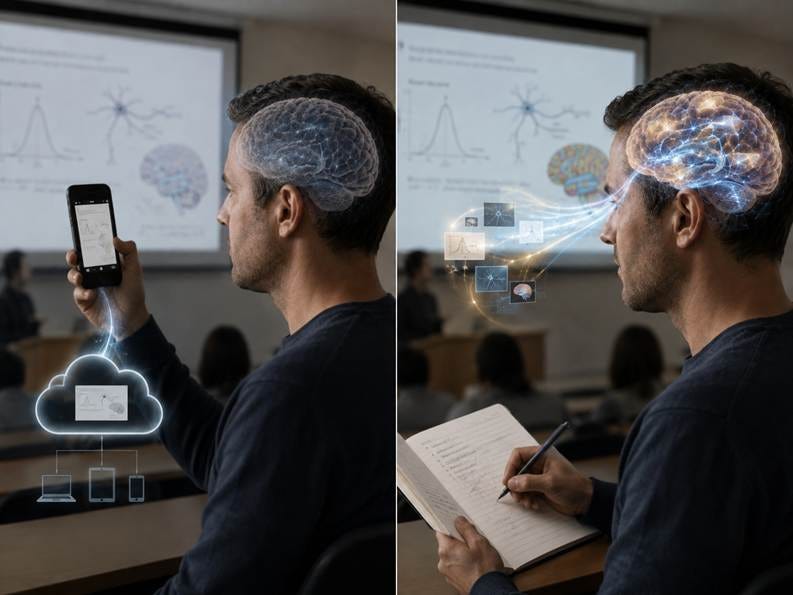
There’s a certain something that always occurs during my keynotes even though I ask the audience not to use their WMDs (Weapons of Mass Distraction). I present a slide containing something the audience apparently finds important (a model, a quote, a diagram, a summary of important results) and almost immediately, a slew of smartphones rises from the audience and with a few quick taps, the slide has been captured and the phones momentarily disappear.
If I were generous – not really my style - I could interpret this as: (1) they find the slide important or interesting, (2) they want to remember it, and (3) they think that the best way to do this is to take a picture. Of course it’s a great way to post something on social media, and since I’m often in the picture too it’s great PR for me, but for remembering? I don’t think so, but I also, until now, had no proof that they were just kidding themselves.
A fascinating new paper by Sophia Fabrizio, Rebecca Lurie, and Deanne Westerman, Digital amnesia: The aftermath of a screenshot, supports that doubt (thanks Carl Hendrick for the tip). Across seven preregistered experiments with 892 participants, they investigated what happens to memory when people shoot something rather than just look at it. [Pity that they didn’t compare it to taking notes on the image.] The result is remarkably consistent: people remembered the screenshotted material worse than just viewing, even when the researchers manipulated whether participants expected a test.
Generated by ChatGPT
Generated by ChatGPT
The finding itself isn’t really new. We’ve known for some time about what’s called the photo-taking impairment effect (Henkel, 2014): photograph something and, under many circumstances, you subsequently remember less of it than if you had simply looked at it. Think about this the next time you’re on vacation and are constantly photographing what you see instead of enjoying the view. What makes Fabrizio et al’s study especially interesting is that the effect extends to one of our most mundane digital behaviours. There’s no complicated camera to operate, no fiddling with focus or exposure or depth of field. The participants used their own smartphones, and carried out something they were utterly familiar with. Yet the simple act of making the digital ‘memory’ was associated with poorer remembering.
The obvious explanation is cognitive outsourcing (Fabrizio et al refer to this as offloading, but if you’ve read my recent blogs, you’ll see that it’s actually outsourcing). Why remember something yourself if your telephone can remember it for you? You’ve outsourced the memory to your phone! We do this all the time, and often very sensibly. I don’t memorise every appointment because my calendar does that for me. But I do have to enter it myself, just like I did with a paper calendar in my vest pocket. We’ve always externalised different forms of cognition; notebooks/notepads, diagrams, to-do-lists, shopping lists are all tools for cognitive offloading. We don’t have to maintain them in our working memories allowing us to use that space for other things. There’s nothing wrong with that, as long was we’re originally doing the thinking (i.e., cognitively processing the information). If we aren’t then we’ve outsourced that processing.
And here’s where the paper becomes particularly interesting. If taking the screenshot was really offloading, allowing us to stop remembering the captured information, perhaps the cognitive resources thereby freed become available for something else. That would at least give us a trade-off: I remember this less, but as a consequence I can think about or remember something else better.
Fabrizio and colleagues went looking for precisely those benefits but had difficulty finding them. Screenshots didn’t improve memory for where information had been encountered, didn’t improve performance on a subsequent cognitively demanding arithmetic task, and didn’t improve memory for things encountered afterwards. One experiment produced a modest benefit for later learning, but only under rather specific conditions and when recall was scored leniently. As the authors conclude, benefits appear to be the exception rather than the rule. In other words, “I don’t need to remember this because I have photographed it” may be a very bad bargain. You sacrifice the memory but don’t reliably get the supposed cognitive dividend.
Even more intriguing is that the authors aren’t convinced that deliberate offloading [their words] explains the phenomenon at all. In later experiments - remember they had seven - they explicitly encouraged situations where strategic offloading should help. Participants knew they needed to remember the material; some were even told that they would be able to consult their screenshots before the test and that the test would not take place for a month. If people were consciously deciding “my phone remembers, therefore my brain doesn’t have to”, these manipulations should have mattered. But they didn’t; the memory deficit remained.
The authors therefore consider another, possibly more plausible explanation, namely attentional disengagement. Taking the screenshot may itself signal, at some level, that our cognitive work is done. We saw the slide, heard what the presenter had to say, so brain: stop processing. We’ve captured the information, and psychologically (cognitively) we move on. Especially telling is that participants weren’t only worse at remembering the screenshotted pictures; they were also worse at remembering their source, suggesting poorer encoding of the surrounding context as well.
And now we return to the presentation I’m giving. I’m speaking about something that I hope people find interesting and will want to remember. A diagram appears on the screen. Someone thinks, “Hey that’s important.” Out comes the phone. They frame the slide, press the button, inspect the little image for perhaps half a second and put the phone away. From the audience member’s point of view: Mission accomplished. Except that I assume that the mission wasn’t to possess a JPEG of my PowerPoint slide, but rather to learn something.

This distinction is important because learning requires changes in long-term memory (Kirschner, Sweller, & Clark, 2006). To learn, information must be attended to, interpreted, connected to what a person already knows, elaborated upon, and ultimately, made retrievable. Taking a photo accomplishes none of these things. It produces an extraordinarily faithful external representation while at the same time producing a really poor internal one (if at all). Capturing information ≠ acquiring knowledge.
There is a certain comic irony here. When someone takes a photograph of one of my slides, they may feel that they have been especially diligent. They’re not ignoring the presentation; quite the contrary, they’ve identified something that they think is valuable enough to preserve. But that very act of preservation may have give their cognitive system permission to disengage from it. The photograph then joins hundreds or thousands of others in a digital graveyard, as the authors say, “buried somewhere in their camera roll”.
And this is where an important qualification is necessary. The researchers didn’t study people photographing PowerPoint slides during keynote lectures. Their participants mostly screenshotted visual material under controlled lab conditions. This means we can’t turn an interesting set of experiments into another breathless proclamation that “research shows hat photographing slides destroys learning”. Research showed no such thing.
Nor do the authors argue that screenshots are always harmful. Their experiments concern digitally captured material that is subsequently not revisited. A carefully chosen screenshot that you later retrieve, study, annotate, compare, discuss, or use for retrieval practice can obviously be useful. [Pardon my cynicism here, but I really don’t think that many of those taking the photos do that, but I haven’t studied that so I may be wrong here.] External memory aids work when they are actually used as memory aids. The authors explicitly make this distinction: a small number of intentional screenshots followed by genuine re-engagement may support memory through rehearsal, while accumulating unreviewed screenshots imposes the cost without obtaining that benefit.
So maybe I should say to my audience when they point and click, “Before you click, think about the slide. Ask yourself why you want to take the photo, write that down, and if you still want the photo, then take it”, but I probably won’t.
Yes, your phone has an excellent (photographic) memory but unfortunately, you don’t get to borrow it. There’s no usb-cable or Bluetooth connection from your phone to your brain.
Fabrizio, S. P., Lurie, R., & Westerman, D. L. (2026). Digital amnesia: The aftermath of a screenshot. Memory & Cognition. https://doi.org/10.3758/s13421-026-01921-2
Henkel, L. A. (2014). Point-and-shoot memories: The influence of taking photos on memory for a museum tour. Psychological Science, 25(2), 396-402. https://doi.org/10.1177/0956797613504438
Kirschner, P. A., Sweller, J., & Clark, R. E. (2006). Why minimal guidance during instruction does not work: An analysis of the failure of constructivist, discovery, problem-based, experiential, and inquiry-based teaching. Educational Psychologist, 41(2), 75–86. https://doi.org/10.1207/s15326985ep4102_1
For me, yes, taking a slide photo probably does interfere with memory and recall. But I am generally taking notes electronically, so later when I review the notes, that photo becomes very valuable. I’d never have typed fast enough to capture it.
And I use those notes for blog posts, articles, and sometimes even my books.
This resonates with something I experienced recently personally. I met my family members after a long time and we were all so absorbed in talking and catching up that nobody thought to take a single photograph. At the time it almost felt like an oversight - shouldn't we have "captured" this?
But looking back now, I realise I remember that gathering with unusual clarity - who was sitting where, who said what and when, even small details like what people were wearing. I have a sharper memory of that afternoon than of many other occasions where I did take photos.
Reading your explanation of attentional disengagement, I think I understand why. There was no moment where any of us reached for a phone and let our brains quietly clock out because "it's been captured." We had nothing to outsource the moment to, so we stayed with it. I also find myself recalling that afternoon more often than any other ocassion precisely because I have nothing to outsource those moments too and recalling it often seems to be the only way to committing it to long term memory so I can go back to it in future.