Irony Squared
Our journey towards a post-literate society

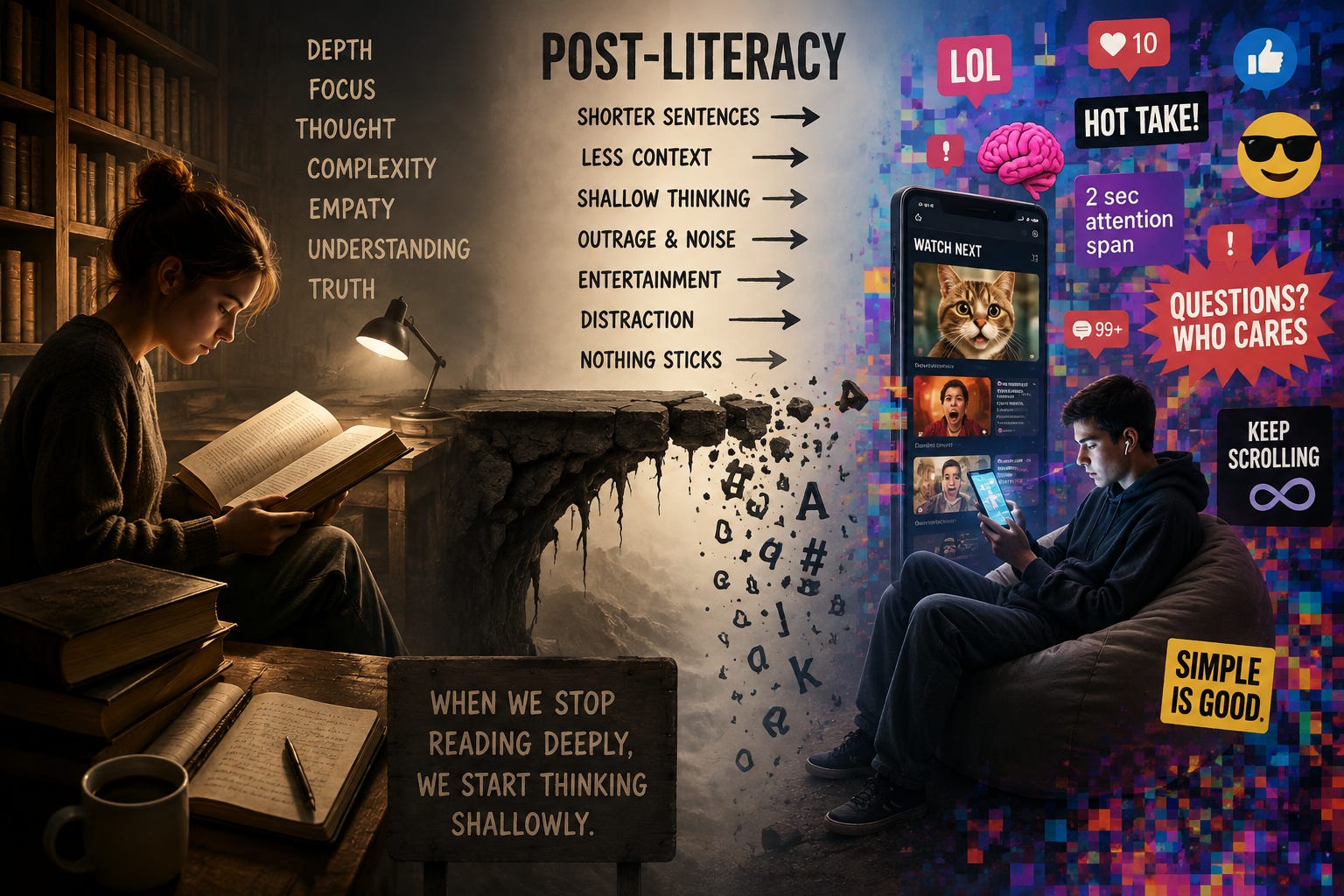
Illustration: ChatGPT / Text: Me
My dear friend and colleague Pedro De Bruyckere attended me to this article - The End of Reading Is Here by Rose Horowitch - in the Atlantic. If I were to use two words to characterise it, they would be dark and apocalyptic. In essence it’s a saunter through the history of literacy beginning with the Library of Alexandria through artificial intelligence, the role and function of reading and writing for our thinking our brain and society in general, and the effects of our loss of literacy in what is called the post-literate society. It’s one of the darkest articles that I’ve read in a long time and isn’t really something someone should read first thing on a cheery, sunny, weekend morning. It’s also very ironic and that’s what I want to discuss here. For the dark and apocalyptic I would suggest everyone who is still literate take the time and make the effort for this longread.
The first irony that I saw was that it’s a longread full of long, thoughtful, deep sentences; a joy to read. It’s full of references both to what has earlier been said in the article as well as to history, psychological and media research forcing the reader to think and make inferences, those things that it also argues that we have and are becoming less able to do, namely read long and intricate sentences in large pieces of text. Horowitch writes, “New York Times best sellers today have sentences that are about one-third shorter than they were a century ago.”
In 1958, the English translation of Boris Pasternak’s Doctor Zhivago was the best-selling novel of the year, according to Publishers Weekly. Pasternak writes in long, complex sentences: “On that warm gray morning in the mountains, Zhivago felt sorry for the Tsar, was disturbed at the thought that such diffident reserve and shyness could be the essential characteristics of an oppressor, that a man so weak could imprison, hang, or pardon.”
The most popular novel written for adults [last year] was the romantasy adventure Onyx Storm. Whatever the book’s pleasures, it isn’t Pasternak: “A muscle in his square jaw ticks as he stares down at me, rippling the tawny-brown skin of his stubbled cheek.”
In that respect it’s preaching to the converted, something I also often tend yo do. It also limits the audience that can/will read and understand it as you need to take the uninterrupted time to read and think about it. It’s exactly the opposite of what today’s, younger, readers can and will do. Horowittch herself notes this when she writes, “But the people devoted to text, who derive cultural understanding and intellectual connection from the written word, are now part of a subculture. The fact that you are reading this article almost certainly makes you a member of it.” Oh the irony.
The second irony was that directly under the title is the possibility to not read it, but rather to listen to in (53 minutes and 24 seconds). Yes, I understand that at this moment in time all text from all sources including my own books must be partially or completely afforded the possibility of their being transformed in real time from written texts to AI-produced oral texts. Yes, it definitely makes the text more inclusive for those with visual impairments, but it’s still ironic to me. Being able to listen to the text, amongst other things, makes the text oral and, thus, allows the you – now the listener and not the reader - to do other things while listening to it removing the possibility of thinking about it while listening because our attention is limited and the possibility to reread passages and think about them is lost due to orality’s ethereal nature (i.e., once said it floats away into the ether; it is transitive). Horowitch discusses these and other differences (and limitations) of oral language in the article. She discusses the difference between literacy and oracy and the repercussions of the trend from the former to the latter, ultimately handling Ong’s discussion of ‘Literacy and Oracy’[1] and our arrival in a post-literate society. To quote Horowitch,
Because spoken words disappear as soon as they’re uttered, oral cultures value repetition to aid memory. Bards in oral societies make use of stock phrases and mnemonics to keep track of their train of thought. They traffic in epithets and “enthusiastic description of physical violence,” in Ong’s words, because conflict is more memorable than dispassionate discussion. Speakers can’t edit their words the way writers can, so they press on without admitting their mistakes. If they later contradict themselves, they don’t expect the audience to recall their earlier statements. Meaning depends on the identity of the speaker, not on any concept of objective truth.
This is best illustrated by Donald Trump being “our first postliterate president”
It is unlikely that Donald Trump has familiarized himself with Orality and Literacy. But if he did, he might recognize himself in Ong’s description. Trump’s communication style is perfectly suited to an oral society. He employs epithets—“Low-Energy Jeb,” “Little Marco,” “Sleepy Joe”—that are easy to remember and repeat. He contradicts himself as though there is no record of his previous statements. Even his writing is almost indistinguishable from his speech. (It makes sense; Trump reportedly prefers dictation to composition.) His online posts are full of idiosyncratically placed punctuation, capital letters, and exclamation points. Many are memes with little text: One featured an image of an American warship hitting an Iranian airplane with a laser beam and included the phrase “Lasers: Bing, Bing, GONE!!!”
I would have loved to end this post in a sunny way on this sunny weekend, but can’t so I’ll just quote Horowitch here again.
Could the generations growing up with their brains hooked to endless video feeds be developing some kind of novel, as-yet-undetectable cognitive brilliance? Perhaps. But for now, the decline of reading seems to be ushering in a less rational, analytical, and sophisticated mode of thinking. It’s difficult to see any advantages in that.
And here’s an interview with the author on Plain English with Derek Thompson:
Horowitch, R. (2026, July). The end of reading is here. Atlantic.
[1] Ong, W. J. (1982). Orality and literacy: The technologizing of the word. Routledge.
Superb. I’m glad to be part of the minority she claims will read the article! But I wonder if a better term than “postliterate” couldn’t be had - it seems to portend a death of literacy, which she clearly shows isn’t happening (and that I don’t think will occur). I wonder if something like “post-longform literacy” wouldn’t be more descriptive?
And I have to add, considering the present company, that we are seeing a phenomenon that started earlier this century. 2010-12 NAEP scores show a stagnation and subsequent drop after years of increases. Many workers attribute this to the introduction of smartphones. I think that’s correlative but there was something else going on at this time (and in the years before) - the instantiation of the skills-based/21st Century skills movements. I think we’re seeing the effects of nearly two decades of poorly executed discovery learning, which worked in a vacuum of knowledge and disciplined longform reasoning. Part of this issue in Horowitz’s article rests on the back of misguided pedagogy.
As a middle school English teacher, I’m seeing the post-literacy process play out in real time. This is never more so dramatic as since the covid lock-downs. My students don’t/won’t read. Their parents don’t/won’t read. The education system is more interested in accommodating students and finding alternatives to long-form reading, offering speech-to-text, text-to-speech, audio books and more. Kids don’t/can’t think anymore. Simply ask an 8th grader, “Why?” to any situation and they cannot even fathom what you’re asking. Despite all this, I fight tooth and nail every school year to get kids to read. I read to them from books and stories to hopeful spark some interest. I introduce new topics in every possible subject to spark some interest. There just isn’t any curiosity on the part of kids today. They don’t want to discover. They want to “google” it. That is all. I’ve never feared for the future more.