
Another day, another apparently simple (old) technique to improve learning: pre-questions. And, to be fair, this one can help. In a large ManyClasses study across 30 classes and 1,571 students (and 33! authors), pre-questions – a technique pioneered by Ernst Rothkopf and Larry Frase at Bell Telephone Labs in the 1960s and ’70s - given before short instructional videos produced an overall improvement in later performance. As a small aside, my first pieces of published research back in 1978 were on the use of pre- and post-questions in videotaped learning materials[1], and I was the not-credited second author in Christiaan Hamaker’s article on adjunct questions in Review of Educational Research.
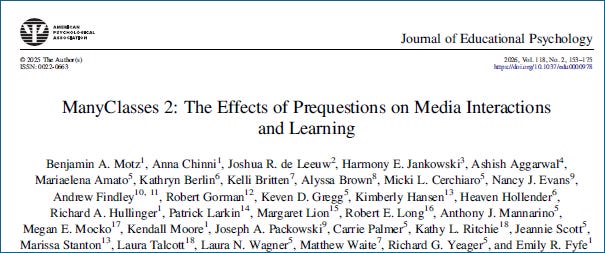
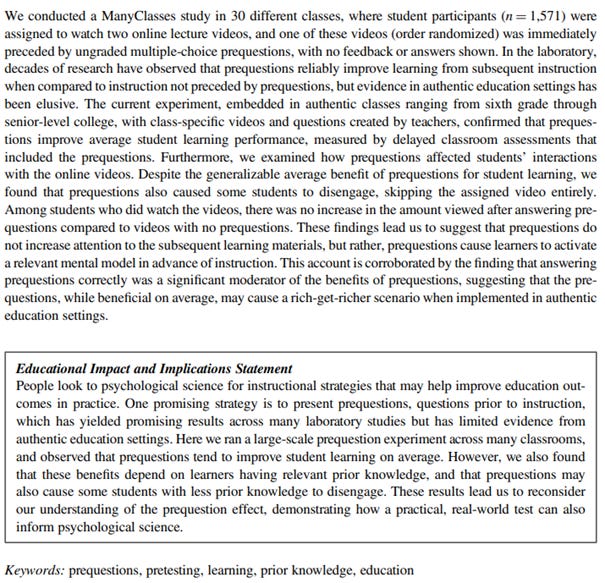
But the interesting part is not that they worked but rather why they worked. The authors found no evidence that pre-questions made students pay more attention to the lesson. They didn’t watch more of the video after receiving the pre-questions; if anything, video viewing went down with some students not watching the video at all. The authors’ explanation was that the pre-questions seemed to work because they activated a relevant mental model in advance of instruction. In plain English, pupils learned better not because the question made them “try harder,” but because it helped them connect the new material to something already in memory.
And that, of course, is key because if the benefit depends on students already having some relevant prior knowledge, then pre-questions aren’t simply a neat little classroom trick and are not without dangers! The danger is that they may also produce a Matthew effect: the students who already know more are more likely to benefit, while those with less prior knowledge may gain little and even disengage. The paper says this quite directly: pre-questions may create a “rich-get-richer” and an accompanying poor-get-poorer pattern in authentic classrooms.
And this is where a knowledge-rich curriculum matters, though the authors don’t say anything about it. At least this is my humble inference from the research, which I feel follows directly from the findings. If pre-questions only help when students have something relevant already stored in long-term memory, then the way to tame the Matthew effect is not to arm materials such as texts, videos, and audio (e.g., podcasts which I too studied[2] with Anguelina Popova and Rich Joiner) with pre-questions. It is to ensure that ALL pupils possess the background knowledge, vocabulary, concepts, and schemas needed to profit from them in the first place. A knowledge-rich curriculum gives more students something to think with when the question arrives.
So the lesson here isn’t, “Use pre-questions because the research says so.” The message is: learning doesn’t float free from curriculum. It lives or dies by what students already know. And we know that since 1963 (David Ausubel and the Psychology of Meaningful Verbal Learning). And that means that the most powerful equity strategy often isn’t some clever activity or quick-fix, but a curriculum that systematically builds shared knowledge over time. Unfortunately, this is far less fashionable than talk of motivation, engagement, or grit. But it is probably closer to the truth.
[1] Kirschner, P. A. (1978). The effect of adjunct question position, type, and the presence or absence of feedback on learning from a videotaped lesson. D. Brook & P. Rice (eds.), Aspects of Educational Technology XII, Kogan Page.
Van den Brink, H. J., & Kirschner, P. A. (1978). Het effect van ingelaste vragen op het leren van op videoband opgenomen lesmateriaal: Veldexperiment [The effect of adjunct questions on learning van videotaped learning materials: Field experiment]. Registratie, 10(3), 13-18.
Van den Brink, H. J., & Kirschner, P. A. (1978). Het effect van ingelaste vragen op het leren van op videoband opgenomen lesmateriaal: Laboratorium experiment [The effect of adjunct questions on learning van videotaped learning materials: Laboratory experiment]. Registratie, 20(4), 4-9.
[2] Popova, A., Kirschner, P. A., & Joiner, R. (2013). Effects of primer podcasts on stimulating learning from lectures: How do students engage? British Journal of Educational Technology, 45, 330-339. doi:10.1111/bjet.12023
Popova, A., Kirschner, P. A. & Joiner, R. (2014). Enhancing learning from lectures with epistemic primer podcasts activity – a pilot study. International Journal of Learning Technology, 9, 323–337. doi:10.1504/IJLT.2014.067735
Thank you for this — the connection to equity and shared knowledge is something I think about a lot in my own practice.
As an instructor in second language learning, I've developed a system for myself that follows a similar logic. First, I decompose the skill or concept and consider what my students already know — their strengths and gaps. Then I deliberately choose what type of prior knowledge to activate: structural knowledge, meaning, or even shared emotional experience, which can sometimes bypass complex language barriers entirely. Finally, I select instructional strategies around that — questions, examples, and the like.
The payoff is visible: you can see and feel those aha moments from students when the new material connects to something they already carry with them.
Ever been to a comedy club where the comedian tells a joke and nobody laughs? This year I have a particular period of students who are that audience, and it’s their woeful lack of prior knowledge for which I’ve had to account in my instruction.
My favorite curriculum, Saxon,(the only one I’ve used that interleaves practice), would devote the first 24 lessons of their Algebra 1 text to 5th-7th grade concepts; a brilliant reinforcement of the requisite prior knowledge for Algebra 1 when California required it in 8th grade.
Prior knowledge is the key.